You plug in your 72V EV bike at night and the charger light turns green. In the morning the display shows 84V, or maybe 82V, or 79V. You start wondering if the battery is full, if the charger is weak, or if the BMS is cutting off early.
This post gives you the real numbers for a 72V lithium battery full charge voltage, the voltage when empty, and how to tell a tired charger from a healthy pack. It is written for riders in Pakistan who deal with long summers, load-shedding and delivery shifts.
Quick answer
What is the 72V lithium battery full charge voltage?
The 72V lithium battery full charge voltage is 84V for a Li-ion pack (20 cells at 4.2V each) and about 87.6V for LiFePO4 (24 cells at 3.65V each). Your display may show slightly less under load. A 76V pack charges to about 88.8V for Li-ion.
What is the full charge voltage of a 72V lithium battery?
A 72V lithium battery full charge voltage is 84V for Li-ion and about 87.6V for LiFePO4. That is the number you should see on a multimeter or display when the charger stops and the pack rests for a few minutes.
The 72V figure is nominal, not full. Li-ion cells are 3.6V nominal and 4.2V full, so 20 cells in series give 72V nominal and 84V full. LiFePO4 cells are 3.2V nominal and 3.65V full, so 24 cells give 76.8V nominal and 87.6V full. Both are sold as 72V packs.
- 72V Li-ion: 20S, 84V full charge.
- 72V LiFePO4: 24S, 87.6V full charge.
- 76V Li-ion: 21S, 88.2V to 88.8V full charge depending on the BMS setting.
Why does a 72V pack read 84V when fully charged?
Because the charger pushes each cell to its top voltage, and those voltages add up. A 72V Li-ion pack has 20 cells in series. Each cell at 4.2V gives 84V at the terminals.
When you unplug the charger, the voltage settles a little. You might see 83.5V or 83V after an hour. That is normal. The BMS also balances the cells at the top, so the first full charge after installation can take longer.
If your display shows 84V right off the charger and drops to 82V under acceleration, the pack is behaving normally. Voltage sag under load is covered below.
What is the difference between 72V and 76V lithium packs?
A 72V pack is 20 Li-ion cells in series; a 76V pack is 21 cells in series. The extra cell raises the full charge voltage to about 88.8V and the nominal voltage to 75.6V.
You cannot choose 76V just because you want more speed. The controller must be rated for it. Most 72V controllers accept 76V, but some have capacitors and MOSFETs that are close to their limit. Always confirm with the bike model before ordering.
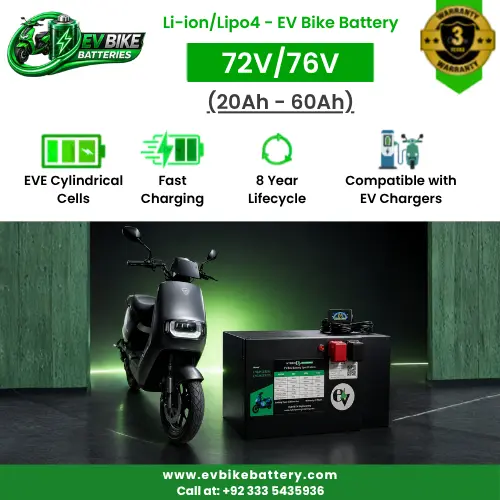
At EV Bike Battery we build both 72V and 76V packs in 20Ah to 60Ah. The 72V & 76V Li-ion / LiFePO₄ EV Bike Battery (20Ah-60Ah) starts at Rs 79,000 for the 20Ah pack. Larger capacities are quoted on booking.
What voltage should a 72V lithium battery show when empty?
A 72V Li-ion pack should cut off around 60V to 63V, and a 72V LiFePO4 pack around 60V to 66V. Those are the BMS low-voltage cut-off points. You should not ride until the bike stops.
For daily use, plan to charge when the display shows about 66V to 68V for Li-ion. That leaves a safe margin and keeps the cells balanced. LiFePO4 holds a flatter voltage curve, so 66V to 69V is a good recharge point.
If your bike cuts off at 70V or higher, the BMS may be set conservatively or one cell group may be weak. That needs a load test, not a guess.
How do I know my 72V charger is working correctly?
Measure the charger output with a multimeter when it is not connected to the bike. A 72V Li-ion charger should read 84V, and a LiFePO4 charger about 87.6V. If it reads 80V or 88V, stop using it.
Then check the charging behaviour. The charger should run its fan, heat up mildly, and switch to green when the pack reaches full voltage. If it stays red for many hours and the pack never crosses 82V, either the charger is weak or a cell group is out of balance.
Do not open the charger unless you are trained. Mains voltage inside can hurt you. Bring it to the workshop for a check.
Why does voltage drop under load on a 72V EV bike?
Voltage drop under load is normal. When you accelerate, the motor pulls a high current, and the battery voltage sags. A 72V pack that rests at 78V might show 72V during a hard climb.
The amount of sag depends on the pack’s internal resistance, the state of charge, and the current draw. A new pack with EVE cells sags less than an old pack. In summer heat, the BMS may also limit current to protect the cells.
If the display drops below 66V under normal riding and the bike feels weak, the pack is either nearly empty or tired. Check the resting voltage after a short rest.
When should I worry about my 72V battery voltage?
Can I replace a 60V battery with a 72V lithium battery?
Not safely. The pack voltage must match the controller. A 60V controller is built for a 60V pack, and feeding it 84V can damage the capacitors and MOSFETs.
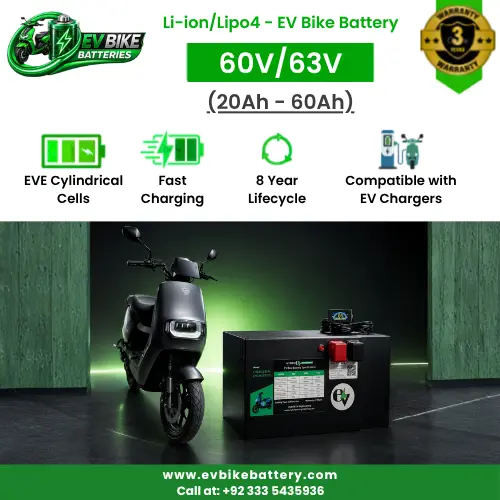
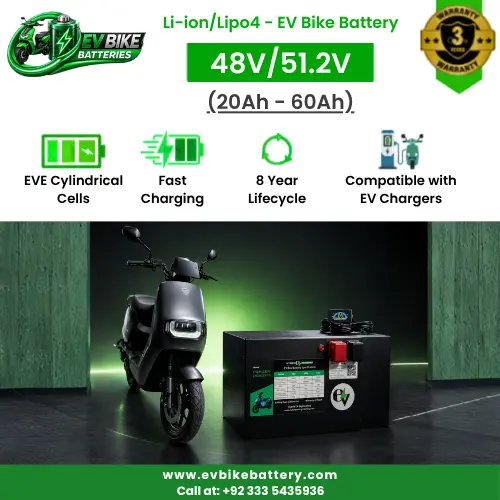
If you want more range, choose a higher capacity 60V pack instead. The 60V & 63V Li-ion / LiFePO₄ EV Bike Battery (20Ah-60Ah) starts at Rs 67,000 for 20Ah. For 48V bikes, the 48V & 51.2V Li-ion / LiFePO₄ EV Bike Battery (20Ah-60Ah) starts at Rs 56,000.
Send your bike model on WhatsApp to +92 370 4466415 and we confirm the right voltage before you pay anything.
How EV Bike Battery tests 72V packs before handover
Every 72V pack is assembled in I-9 Islamabad with new EVE cells and a smart BMS, then load tested. We check the full charge voltage, the cut-off voltage, and the balance between cell groups.
We also inspect your bike’s controller, wiring and charger during fitting. If the charger output is wrong, we tell you before it damages the new pack. That is part of the free fitting and inspection.
All packs carry a 3-year warranty and 1 year of free service. Nationwide delivery is available in safe packaging.
Not sure which voltage your bike needs?
Send your bike model, a photo of the controller label, and the charger output. We will confirm the right pack and price.
Frequently Asked Questions
What is the full charge voltage of a 72V lithium battery?
A 72V Li-ion battery charges to 84V (20 cells at 4.2V each). A 72V LiFePO4 battery charges to about 87.6V (24 cells at 3.65V each). After resting, the voltage may settle slightly lower. Always use a charger rated for your chemistry.
What is a 72V lithium battery used for on EV bikes and scooties?
It powers the motor and controller on higher-voltage EV bikes and scooties. 72V packs are common on models that need more speed and torque, such as those from Evee, Vlektra, MS Jaguar and Metro. They are built in capacities from 20Ah to 60Ah.
Can I replace a 60V battery with a 72V lithium battery on my EV bike?
No, not safely. The controller must be rated for 72V. A 60V controller may fail if you feed it 84V. If you need more range, choose a higher-capacity 60V pack instead. Confirm the voltage with your bike model before buying.
What should a 72V lithium battery read when empty?
A 72V Li-ion pack should cut off around 60V to 63V. A LiFePO4 pack cuts off around 60V to 66V. For daily use, recharge when the display shows about 66V to 68V to avoid stressing the cells.
Why does my 72V battery show 84V but drop quickly?
Voltage sag under load is normal. If it drops quickly even on a flat road, the pack may have high internal resistance, be nearly empty, or have a weak cell group. A load test at the workshop will confirm.
How much does a 72V lithium battery cost in Pakistan?
A 72V lithium battery starts at Rs 79,000 for the 20Ah pack. Larger 30Ah, 40Ah and 60Ah packs are quoted on booking. Every pack is built in Islamabad with EVE cells and a 3-year warranty.
Final Thoughts
The short version:
- A 72V Li-ion pack charges to 84V; a 72V LiFePO4 pack to about 87.6V.
- A 76V Li-ion pack charges to about 88.8V and needs a controller that allows it.
- Empty voltage is around 60V to 63V for Li-ion; recharge before that.
- Voltage sag under load is normal; a huge sag at rest is not.
- Match the pack voltage to your controller, not to the speed you want.
If your numbers do not match these, send a photo of your display and charger to the WhatsApp box below. For a deeper look at pack life, read How Long Does an Electric Bike Battery Last?.
Get Your Battery Quote