Most riders asking about lithium battery vs dry battery are standing in a workshop with a bike that has stopped giving the range it used to. The dry battery (the sealed lead acid pack most Pakistani e-bikes shipped with) is three or four years old, the charger has been on all night, and the bike still dies halfway through the route.
The question is not really which chemistry is newer. It is which one costs you less per kilometre, which one survives a Lahore or Karachi summer, and which one your controller will actually accept without a headache.
This post compares the two on the things that matter on a Pakistani road: charge cycles, weight on the frame, range per charge, and the money you spend over three years rather than on day one.
Quick answer
Lithium battery vs dry battery: which is better for an EV bike?
A lithium battery beats a dry battery on every count that matters for an EV bike: it lasts 4000+ charge cycles against roughly 300 to 500, weighs far less, holds its range in summer, and costs less per year over three years. Dry batteries only win on the lowest upfront price.
What is a dry battery and how is it different from lithium?
A dry battery is a sealed lead acid pack, often called a dry cell or maintenance-free battery in the local market. It stores energy with lead plates and an acid paste, and it is the pack most entry-level EV bikes and scooties in Pakistan came with. Lithium packs use lithium cells (Li-ion or LiFePO4) with a BMS board that manages every cell.
The practical differences you feel on the bike:
- Weight. Lead is heavy. A dry pack of the same nominal capacity weighs several times what a lithium pack does, and that weight sits low and rear-heavy on a scooty.
- Voltage sag. A dry battery drops voltage under load, so acceleration fades as the pack drains. Lithium holds its voltage flatter until it is nearly empty.
- Cycle life. Lead acid is rated around 300 to 500 charge cycles. Our lithium packs are rated 4000+ cycles.
- Charging. Dry packs are slow and get warm. Lithium packs fast charge with a standard EV charger and a smart BMS watching temperature.
How many charge cycles does each type really last?
On paper a dry battery is rated about 300 to 500 cycles. In a Pakistani summer, with a rider charging every night and doing two trips a day, many packs fall well short of that before range drops badly. Lithium is rated 4000+ cycles, which is the single biggest reason riders switch.
A cycle is one full charge and one full discharge. If you ride 40 km a day and charge nightly, that is roughly 365 cycles a year. A dry pack rated 400 to 500 cycles is therefore on borrowed time inside two years. A lithium pack rated 4000+ cycles is not the part of the bike you plan to replace again.
Heat is what kills both chemistries early. Charging a hot pack straight after a long ride, or leaving a bike in direct sun before plugging in, shortens life on either type. Lithium tolerates this better because the BMS cuts off on temperature, but it is not immune.
Lithium battery vs dry battery: which is lighter and why it matters?
Lithium is much lighter for the same capacity, and on an EV bike that weight saving turns directly into range, climbing ability and less stress on the frame and rear suspension.
Think about what a heavy dry pack does on a 70cc-style EV frame. The rear rack carries the weight, the suspension works harder over speed breakers, and the motor pulls more current to move the same rider up a flyover. Every kilo removed is current the controller does not have to supply.
Riders who switch usually notice two things in the first week: the bike feels quicker off the line, and the same route uses less of the pack. That is not a tuning trick, it is simply less mass to accelerate and hold at speed.
Which one gives more range per charge on a Pakistani EV bike?
For the same nominal capacity, lithium gives more usable range per charge. A dry battery loses voltage as it drains, so the controller cuts off earlier and the last part of the pack is never really used. Lithium delivers a flatter voltage curve, so more of the rated capacity reaches the motor.
Real range still depends on your route, load and riding style. A delivery rider with a loaded rear box, stop-start traffic on Ferozepur Road, and a headwind on the way back will always see less than a solo commuter on a flat road. What changes with lithium is how much of the pack you actually get to use before the bike slows down.
Peak summer is the other factor. Both chemistries lose some range in extreme heat, but a dry pack that is already sagging will feel it much more. If your current pack only gives you a comfortable half-route in June, that is a sign of a tired dry battery rather than a route problem.
Which is cheaper over 3 years, not just at purchase?
A dry battery is cheaper on the day you buy it. Over three years, lithium usually works out cheaper because you buy it once instead of two or three times, and you spend less on charging losses and downtime.
Do the sum on your own usage. If your dry pack costs X and lasts about two years on a daily delivery route, three years means roughly one and a half dry packs, plus the days the bike sits at the workshop. A lithium pack rated 4000+ cycles covers those three years with margin, and it comes with a 3-year warranty and 1 year of free service from us.
The listed price is for the 20Ah pack, and larger capacities are quoted on booking because the pack is built to your bike and route.
For the full range of voltages and capacities, see the EV Bike Battery category. If you are still deciding between a smaller and a bigger pack, our guide on 48V vs 72V lithium battery for EV bikes in Pakistan walks through the trade-offs.
Can I replace my dry battery with a lithium pack directly?
Usually yes, but not by simply dropping a lithium pack into the old battery box. The controller, charger and wiring have to match the new pack, and the voltage must be confirmed against your bike model before anything is ordered.
What a proper swap involves at our I-9 Islamabad workshop:
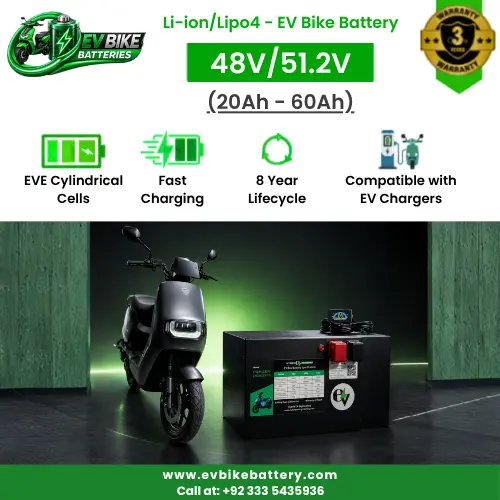
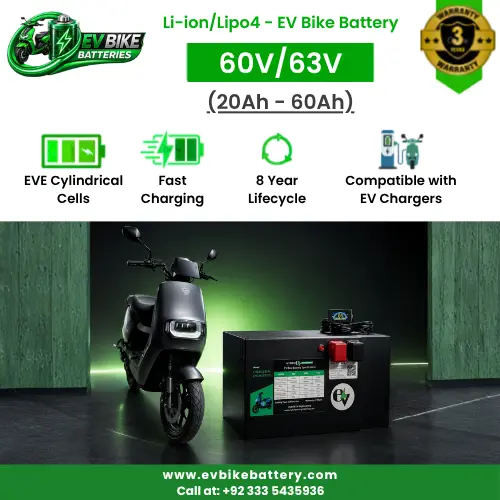
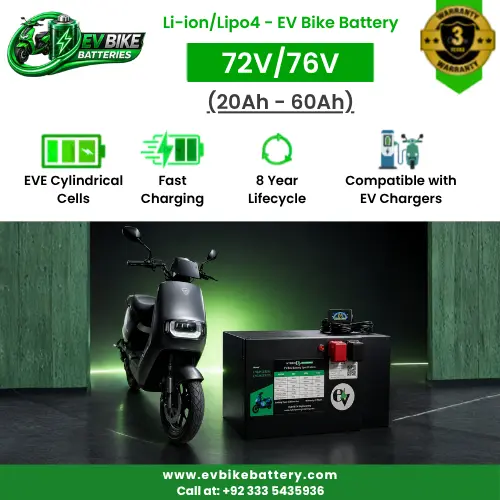
- Check the bike model and the controller’s rated voltage. A 48V bike takes a 48V pack, a 60V bike takes a 60V pack, and a 72V bike takes a 72V pack. The 51.2V, 63V and 76V variants only go in where the controller allows it.
- Inspect the wiring, connectors and battery box for heat damage or loose terminals from the old lead pack.
- Fit the lithium pack with the correct charger and configure the BMS.
- Load test the pack and road test the bike before handover.
Send your bike model on WhatsApp to +92 370 4466415 and the right voltage is confirmed before you pay anything. We fit Evee, Vlektra, MS Jaguar, Metro, Revoo, Jolta, Road Prince, OKLA, Benling and Crown bikes, and handle other brands on request.
Not sure which pack fits your bike?
Send your bike model, current battery voltage and your daily route on WhatsApp. We confirm the right voltage and capacity, quote the exact price, and give you a fitting date at the I-9 Islamabad workshop.
What about Evee graphene batteries vs lithium?
Evee bikes ship with graphene batteries, which are an enhanced lead acid chemistry, not lithium. They are better than a plain dry battery but they still sit in the lead acid family: heavier, slower to charge, and rated in the hundreds of cycles rather than the thousands.
Riders often ask whether to keep the graphene pack until it dies or switch early. If the pack is still giving you the range you need, there is no rush. If you are already charging twice a day, or the bike slows noticeably on the return leg, the pack is telling you it is near the end of its useful life, and moving to lithium at that point saves you buying another lead-family pack first.
Our 60V and 63V packs are built for exactly this swap on Evee and similar bikes. The controller is checked first, because a graphene or lead acid bike does not always accept a lithium pack without confirming the voltage.
Which lithium battery voltage and Ah should I choose?
Match the voltage to your controller first, then pick the Ah by your daily route. Voltage is not a performance upgrade you choose freely; the wrong voltage can damage the controller. Capacity is where you have room to decide.
- Voltage. 48V / 51.2V, 60V / 63V and 72V / 76V packs are all built here. The higher voltage suits bikes designed for it, not a 48V bike upgraded by guesswork.
- Capacity. 20Ah, 30Ah, 40Ah and 60Ah. A short city commute is fine on 20Ah or 30Ah. A delivery rider doing a full shift should be looking at 40Ah or 60Ah.
- Chemistry. Li-ion is lighter and packs more energy per kilo. LiFePO4 is a little heavier but very stable and long lived. Both are available in every voltage we build.
If you want the best lithium battery for electric motorcycle use on a long daily route, capacity matters more than chemistry. A bigger pack charged to a comfortable level lasts longer than a small pack pushed to empty every day.
| Your situation | Voltage | Capacity to consider |
|---|---|---|
| Short city commute, solo rider | 48V / 51.2V | 20Ah or 30Ah |
| Daily 40-60 km commute | 60V / 63V | 30Ah or 40Ah |
| Delivery rider, full shift | 60V / 63V or 72V / 76V | 40Ah or 60Ah |
| Long route, heavy load, flyovers | 72V / 76V | 40Ah or 60Ah |
Which battery should a delivery rider in Pakistan choose?
A delivery rider should choose lithium, and should choose capacity by the shift rather than by the cheapest pack. Two charging cycles a day on a dry battery is the fastest way to burn through packs and lose earning days.
Look at the working day honestly. A rider doing a full shift with a loaded box, stop-start traffic and a few flyovers needs a pack that still has charge left when the shift ends, not one that is on the last bar at 6 pm. That usually means 40Ah or 60Ah at your bike’s voltage, and a spare charger at the restaurant or office if the route is long.
The other delivery-rider factor is downtime. A pack in stock is usually ready in 24 to 48 hours, fitting is free at the I-9 workshop with a free inspection of the bike and wiring, and nationwide delivery is available in safe packaging. That is a shorter break than waiting on an imported pack with no local support.
If you want to understand how long a pack should last before you plan the next replacement, read how long an electric bike battery lasts for Pakistani riders.
Frequently Asked Questions
Which lithium battery is best for an EV bike in Pakistan, Li-ion or LiFePO4?
Both work well. Li-ion is lighter and gives more energy per kilo, which suits riders who want range and pickup. LiFePO4 is a little heavier but very stable and long lived, and it handles heat well. We build both chemistries in 48V, 60V and 72V packs, so the choice comes down to your route and how much weight matters on your bike.
What is the price of a 72V 40Ah lithium battery for an EV bike in Pakistan?
The listed price for the 72V and 76V range is Rs 79,000 for the 20Ah pack. Larger capacities including 40Ah are quoted on booking, because the pack is built to your bike and route. Send your bike model on WhatsApp and you get the exact 40Ah price before you commit to anything.
Is a 48V 60Ah lithium battery enough for a delivery rider’s daily route?
For most city delivery routes, yes. A 48V 60Ah pack is a large capacity and suits a full shift with a loaded box, provided your bike’s controller is rated for 48V. Riders on longer routes or heavier loads sometimes prefer 60V or 72V at 40Ah or 60Ah. Share your daily kilometres and we will confirm which one fits.
Which lithium battery voltage and Ah should I choose for my EV bike in Pakistan?
Voltage must match your bike’s controller: 48V bike takes 48V, 60V takes 60V, 72V takes 72V, with the 51.2V, 63V and 76V variants only where the controller allows. Choose Ah by daily range: 20Ah to 30Ah for short commutes, 40Ah to 60Ah for delivery shifts and long routes.
How long does an EV bike lithium battery last before replacement?
Our lithium packs are rated 4000+ charge cycles. For a rider charging once a night, that is many years of use, and the 3-year warranty covers the early period. Real life depends on heat, charging habits and how deeply you discharge the pack. Charging before the pack is fully empty and avoiding charging a hot pack will stretch it further.
What is a 72V or 76V lithium battery used for on an EV bike?
A 72V or 76V pack is used on bikes whose controller and motor are rated for that voltage. It suits longer routes, heavier riders and loaded delivery bikes that need strong climbing and sustained speed. It is not an upgrade for a 48V or 60V bike, because the controller would be damaged.
Final Thoughts
The short version:
- Lithium wins on cycle life: 4000+ rated cycles against roughly 300 to 500 for a dry battery.
- Lithium is much lighter, which shows up as better pickup and less strain on the frame.
- Lithium gives more usable range per charge because voltage holds under load.
- Over three years, lithium usually costs less because you buy it once, not two or three times.
- Dry batteries still make sense only when the upfront price is the hard limit and the route is short.
- Any swap needs the controller voltage confirmed first. Send your bike model before ordering.
If you are ready to compare packs for your own bike, the replacement battery buying guide covers the models we fit most often, and the WhatsApp box below gets you a confirmed voltage and price.
Get Your Battery Quote